
Software developer · Lomé & remote
Service 01 — Design & development
Custom business applications, built to last
You run your operations on spreadsheets, your internal tool no longer matches your processes, or you have a product to ship. I design the architecture, write the code and deliver an application your team can take over — not a black box.
- Laravel · Symfony · Spring Boot
- Vue 3 · React · Next.js
- Tests, CI/CD, documentation
- 7 years
- designing and shipping web applications to production
- 15+
- projects delivered, from multi-store ERPs to SaaS products
- 100%
- of the code, the accounts and the documentation belong to you
They trusted me


Your challenges
Does your tool still match your business?
- 01
Everything runs on spreadsheets
Files travel by email, nobody knows which version is authoritative, and the smallest consolidation takes a full day.
- 02
The existing system can't keep up
Adding one feature breaks another, the database has drifted, and nobody dares touch it any more.
- 03
A product to ship
You need to put an idea in front of real users before committing the budget of a full build.
- 04
Your tools don't talk to each other
Stock, invoicing, payment, accounting: the same data is keyed in three times, and the discrepancies end up costing money.
Scope
What I design and build
Business application & ERP
Stock, purchasing, invoicing, cash desk, receivables, roles and permissions: the whole chain, with a dashboard per profile and an audit trail.
Multi-tenant SaaS platform
Accounts, subscriptions, per-customer data isolation and an admin back office, designed into the data model from day one.
APIs & integrations
Expose your business logic cleanly, or connect an existing system to a partner: mobile money, insurer, banking switch.
Takeover & rebuild
Pick up an inherited codebase, stabilise it, cover it with tests, then grow it batch by batch without stopping production.
Technologies
The technologies I work with every day
I don't pick a technology because it's fashionable, but because your developers — or your next provider — will be able to pick it up. These are mature, documented foundations with a real community behind them.
Back-end
- PHP 8
- Laravel
- Symfony
- Java
- Spring Boot
Front-end
- Vue 3
- React
- Next.js
- TypeScript
- Tailwind
Data & infrastructure
- PostgreSQL
- MySQL
- Redis
- RabbitMQ
- Docker
Method
From scoping to production, in 4 steps
Step 1 · 3 to 5 days
Scoping
A workshop with your business teams to set the perimeter, the rules and the edge cases — the ones that blow up a budget when they surface halfway through. You leave with a prioritised backlog and an estimate.
Step 2 · 1 to 2 weeks
Architecture & technical foundation
Data model, application layering, Docker environment, continuous integration and the first screens. This is where the cost of the next three years is decided.
Step 3 · 2-week iterations
Development in batches
Every batch lands on a staging environment you test with your users. You make trade-offs as you go rather than at final delivery, and scope stays under control.
Step 4 · 1 week
Go-live & handover
Deployment, migration of your existing data, documentation and onboarding for your team. The goal is that you can carry on without me.
What you get
Deliverables you can use, not a report
The source code, yours
Git repository on your side, full history, clear licence. No dependency on me.
Technical documentation
Data model, architecture decisions and deployment procedures, written as the project goes.
Automated tests
On the business rules that cost real money when they break: calculations, permissions, validation cycles.
A reproducible environment
Docker and a README: the application runs on a new developer's machine with one command.
A deployment pipeline
Every approved change goes to staging automatically, every tagged version to production. No more manual Friday-evening releases.
Why work with me
Three commitments I keep on every engagement
- 01
You talk to the person writing the code
No salesperson, no middleman, no junior swapped onto your project after signature. Whoever scopes the work is whoever delivers it.
- 02
You stay the owner
Code, infrastructure, accounts, documentation: everything sits with you. You can change provider without starting over.
- 03
I say no when I should
If an off-the-shelf tool or three days of advice solves your problem better than custom development, I'll tell you — even when it costs me the engagement.
In practice
An example: the Vonamawu ERP
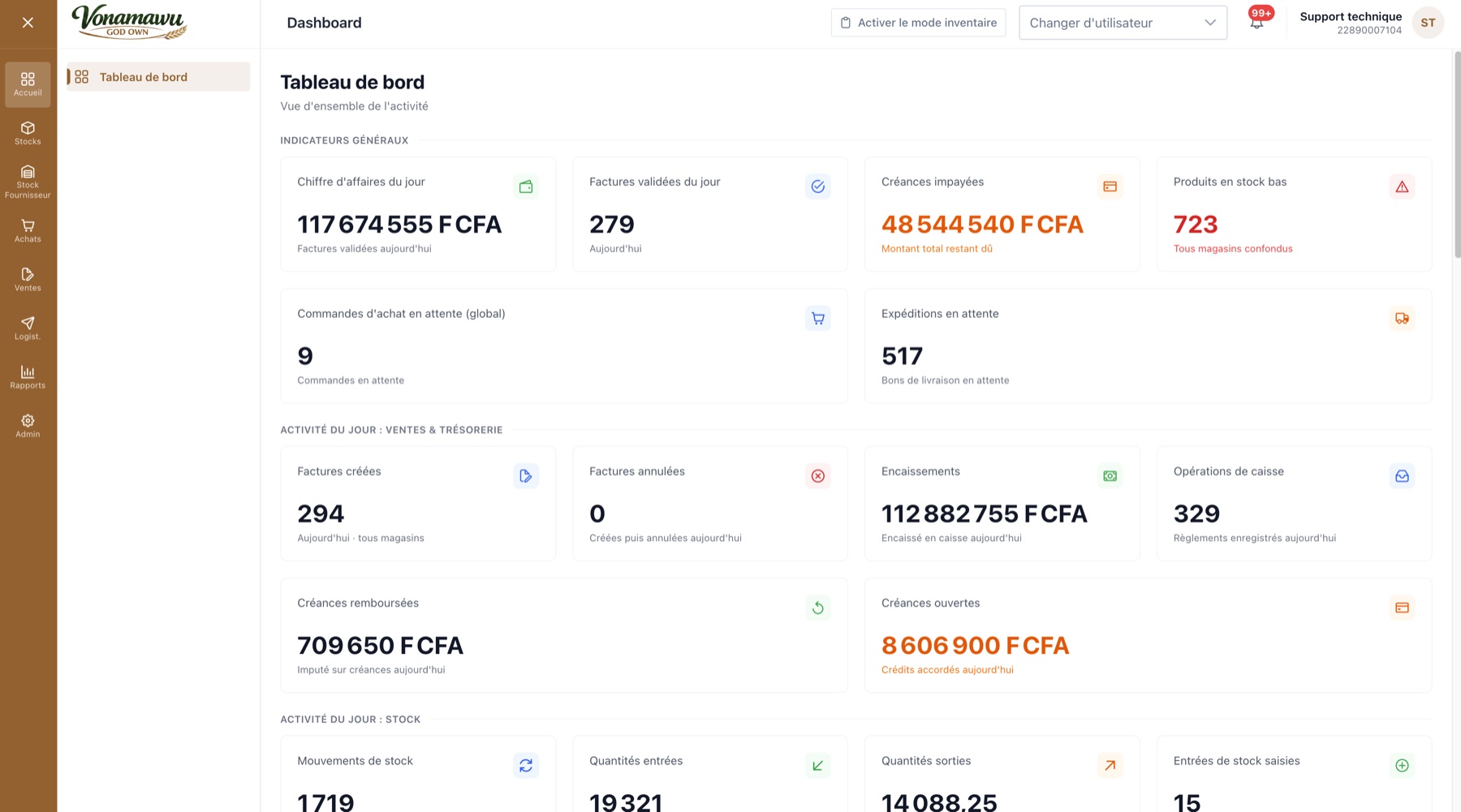
A food distributor was tracking multi-store inventory between spreadsheets and paper notebooks. I designed and built the complete ERP: stock movements, supplier purchase orders, invoicing, cash desk, receivables and reporting — with a dashboard per profile and an audit trail of sensitive actions.
View the project →Frequently asked
What people ask before we start
How much does a project cost?
The budget is set after scoping, once the perimeter is written down — quoting before that would mean inventing a number. To validate an idea quickly, the MVP Sprint is a fixed-scope, fixed-price package.
How long until a usable first version?
Count 6 to 10 weeks for a first production release on a focused business perimeter. An MVP meant to validate a hypothesis ships in one to two weeks.
Do you take over a project started by someone else?
Yes, often. I start with a 3 to 5 day audit to measure the real state of the code before committing to what follows: taking over blind serves nobody.
Who owns the code?
You do, from the first commit. The repository is hosted on your side and I work in it.
Do you work with our in-house team?
Yes, and that's the most common setup: I design the architecture and build the structural parts, your developers take over the rest. I can train the team along the way.
Describe your need in a few lines
I'll answer within 48 hours with a first reading: what I would do, in what order, and what I would not do.
Get in touch